5 Tips for Optimizing Conversions through Live Chat

Although adding live chat has proven to increase website conversions for most, it’s not just the act of adding the application to your site that will lead to increased sales.

To really optimize the benefits of live chat technology, here are 5 things to consider which will have a direct impact on website conversion rates when chats are initiated:

1. Live Chat Agent Competency

The first and most important aspect of driving up conversions with a live chat tool is having the right person in the chatters seat. A well-trained chat agent is key to building relationships with customers over live chat and ultimately, driving sales.

Ideally, when getting started with live chat, the chats should be covered by the business owner or a customer service specialist who has been taking care of other communication channels (email, phone, tweets). Avoid putting inexperienced people in chat seats, although chats agent will have a little more time to response, as opposed to phone support, the answers will be highly scrutinized by customers.

Things to look at closely in the first days of chatting are the kinds of questions and requests that are coming in, when are peak times, which other tools need to be accessed while covering chats and integration needs with other support channels (CRM, Phone, Email). With this information, a structured Live Chat Response document can be created. Essentially, the document serves as a system which a new chat agent can be trained with.

2. Speed of Response

Answering your website visitors within seconds, not minutes, has the potential to increase conversions and customer satisfaction. Don’t make them wait. The expectation of live chat is different than phone or email. Email response times are known to be slower and phone support calls are also know to be slow to connect and start due to queues and call volumes.

Many people use live chat to ask specific questions that require quick answers, many times these questions are directly related to the purchase of products or services. If the visitor is on a checkout page and has a specifics question about shipping details, the slower the response, the less chance there is to convert. Although, I am still surprised at the number of extremely complex ecommerce sites that manage to generate sales. Exceptions I guess. . .

In sum, speed of response will increase with the live chat agents experience, but some things that can help early on are saved responses, minimizing the number of concurrent chats and quick access to customer information - therefore it is extremely helpful for the agent to have access to the company CRM and ideally for the chat tool and the CRM to be linked.

3. Coverage Times

If you have existing traffic data, try to examine optimal coverage times by looking at daily traffic patterns. Because a website is online an open 24/7, full coverage would be the ideal setup, but that’s not always feasible, especially from a cost standpoint, or a sleep standpoint for solopreneurs.

By looking at these traffic patterns you can focus coverage on peak traffic times and save the cost of covering when traffic volumes dip. At first, you can have the live chat running while you multi-task during the day, but preferably you should move to covering these peak times.

You should can a customer service agent to monitor chats as they answer emails and/or take phone calls. This will also increase service quality...and ultimately conversions.

4. Honest and Personalized Service (Psychology)

When chatting with visitors, try to keep in mind that this is the internet and people have different sets of beliefs, values, religions and traditions.. even holidays. Live chat agents needs to be tactful in their communication.

Most live chat tools come with visitor analytics data to empower the agents with enough information to offer personalized, effective and customized service leaving the visitor feeling satisfied and valued. One trick is to begin conversations by asking the visitors name and location, this builds a quick bond or connection before moving on to the issue, questions or topic.

5. Optimize the Live Chat process

Experience, Learn, Iterate. Like anything else in business, live chat support is a process that can be tweaked and optimized over time. Here are a few tips to optimize the process, which in turn will help optimize conversions.

a) If questions come back repeatedly, and it seems core to the offer, maybe this question should be addressed clearly on the home page to help minimize the flow of questions.

b) Minimize churn rates of agents. The time it takes to train a new agent to an independent, high performing level can be 15-30 days for basic, less technical businesses...so keep your agents happy!

c) Have an online self-help area, a live FAQ page on your website or a community and teach/direct your visitors and customers on where to find the answers to their future questions. The time spent will minimize unnecessary chat requests.

These 5 tips for optimizing conversions, needless to say, are quite exhaustive so you might want to refer here every once in a while every time you fee unsure of what to do with live chat on your website. Remember: The “making” in making the sale is an active verb!

- Jon

Published by

Jonathan Kennedy

Co-founder of Offerchat, Jonathan is a Canadian entrepreneur living and working in Cebu City, Philippines. Focused on building a viable global startup from Asia, Jonathan writes about entrepreneurship, outsourcing, eCommerce and agile marketing.

Related Posts

If you enjoyed this topic, you might also like:

What is Live Chat? And Other Questions Nobody Wants to Be Caught Asking

We took to the thinking chair and put on our philosopher’s hats to ponder one of the universe’s most obvious questions everybody doesn’t want to be caught asking — What is Live Chat?

So if you’re wondering what’s up with this latest trend in websites, how it works and what does it look like. . . If you don’t want to ask “stupid” questions for fear of being perceived as dense, then go right ahead and arm yourself with this knowledge.

Quick jump to a topic by clicking a link below:

What is live chat?

How does it look like?

Who uses live chat?

How does it work?

Watch the video

What is Live Chat?

To put it uber-simply, live chat is a tool, app or widget that allows you to chat directly to somebody from the website. This can be the website owner, or a member of the customer service team.

So let’s just say, somebody really missed his AOL days and decided to bring chat back right in his front yard. Seriously.

Live chat is becoming ever-present in websites that sell products or services -- that is, websites that are actually online businesses. It is the primary tool for live chat support or online customer service.

What does it look like?

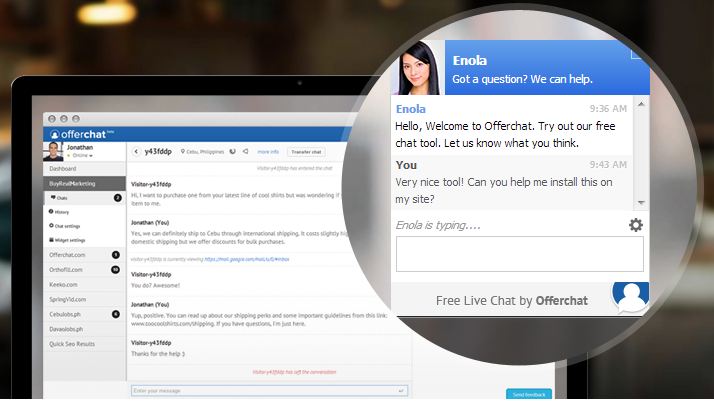
Offerchat live chat support

(Background: Offerchat live chat control panel accessed by a website owner. In circle: How the live chat widget appears on your site as seen by visitors.)

Live chat is becoming ever-present in websites that sell products or services -- that is, websites that are actually online businesses. It is the primary tool for live chat support or live chat customer service.

Who uses live chat?

  • Big companies and corporations
  • Non-profit organizations
  • Blogs

But it’s best for:

  • Small business websites
  • Online Stores / eCommerce sites

Basically, any website who want or need to provide an instant messaging platform to its audience or site visitors as an online customer service touch point.

How does it work?

Most live chat programs today need only to be embedded on a website by inserting a line of code to a website’s HTML header or body. Some providers make website specific plugins to make the installation easier. For example: WordPress live chat plugin, Prestashop live chat module.

The unique code is given after registration and should be added to a single website only for customization purposes. Should you want to add a chat widget to another site, add another site from the live chat dashboard and you will be given another widget code.

Once the code is added to a website, the chat widget will immediately appear. By default, the widget will be minimized to avoid getting in the way of visitors viewing your site.

live chat for website

(Example website with an Offerchat live chat widget expanded showing an ongoing chat conversation.)

Customization options to change the widget’s appearance and color, as well as labels and language used are available by accessing the control panel or dashboard. This is done by logging into your live chat provider’s website.

As soon as you log in to your account and access the dashboard, the chat widget on your website will appear as online, signaling your visitors that you are available. When a visitor on a page of your site clicks the widget to expand and chats with you, the chat message will appear in the chat view on your dashboard along with some notifications (ticker flashes on your browser tab along with a sound alert) to let you know that a visitor is chatting.

Skip the Textbook, I’m no Dinosaur

Watch the explainer video to wrap your head around live chat and how it can help you get more product users:


Published by

Cheby Labrague
Cheby Labrague

Cheby writes about live chat insights, improving conversions, epic customer service, online marketing and everything in between. She will take you by the hand in exploring how to extend your website's earning power through Offerchat's smart live chat tool, and even smarter live chat people.

Related Posts

If you enjoyed this topic, you might also like:


What Customers Hate the Most: Top 3 Bad Customer Service Habits to Break

Getting rid of bad customer service habits works pretty much the same as when you’re trying to stop any other bad habit such as overspending, shoplifting, philandering, smoking or one utterly dangerous and life-threatening habit like nose picking.

Firstly, you have got to be aware of, acknowledge and own the habit completely before any changes can be made. Without this crucial first step, no amount of external convincing or correction will ever be truly effective.

What customers hate the most

Bad customer habits you’re not aware of might be the very reason why your sales and conversions are as pale as Edward Cullen. A survey released by Dimensional Research on April this year identified (finally!) the top 4 instances US consumers identify as bad customer service interactions with mid-sized companies.

- Explaining their problem to multiple people 72%

- Unpleasant staff 67%

- Resolutions taking too long 65%

- Problem not solved 51%

Now let’s take these 4 notorious cases and translate them to bad customer service habits.

Spring Cleaning Bad Customer Service Habits

Bad habit #1: Being a Bad Listener

When I was working as tech support, I often catch myself “partly” listening to customers calling in. While they mildly rant, I’m carefully rehearsing explanations in my head or thinking about my next move -- a transfer to another department most likely. And when I’m done I’d just spew it out, cutting them off.

There goes the 80-20 rule out the window.. and down the fire escape.

Sounds uncannily familiar? Chances are we have the same habit! Now here’s what I did, I deliberately bit my tongue every time I get the urge to take control. The next time you feel like opening your mouth to present your side, bite that tongue for a sec. Practice the 80-20 rule which is 80% customer talking and 20% you. Spend the 20% demonstrating full understanding of the problem and the outcome being asked while actively reassuring it will flow through the pipes as needed. It’s only when we’ve listened completely and fully that the probability of them repeating themselves to our support team will remarkably lessen.

Kill the habit: Bite your tongue. Listen, iterate, and document. For live chat agents, offer to review the chat logs immediately if it’s a transfer or a repeat contact. And make sure to get their issue or problem right.

Bad habit #2: Forgetting courtesy

Yes, it’s a busy day. We’re so buried in our routine that most of us develop the tendency to be apathetic and to treat another chat or call as “just another...” forgetting there’s a real, living human being at the other end. Simple courtesy starts and ends at our automated greeting. Hardly any room for politeness as we dash to answer customer questions. Have you snapped at a somebody today?

Kill the habit: Smile. Yes, even if you’re just facing the screen and typing out responses. Believe it or not, our customer service mentor back then had us bring mirrors to be placed right beside our individual screens. I thought it was dumb smiling at myself there every.single.time! But damn that raised my customer satisfaction score. So again: stick a mirror in front of you, and smile. Just do it.

Bad habit #3: Putting off work for later

The drone of urgency reverberates throughout the day. With different kinds of support you are receiving, prioritization is a must. Some cases stay in the limbo indefinitely while solutions are still being worked on. Things can fall through the cracks quickly. At this point, we can be procastinating on solutions deliberately or unconsciously. Customers may have to contact again to ask for updates, and explain the situation to a staff again (see #1) which can then restart the ominous cycle of stress. It can ruin your metrics too!

Kill the habit: Put a system in place. Have a list of unresolved contacts and a calendar for initial follow up after 3 days and after a week. Customers appreciate it when they are updated or are given the honest, hard truth. Yes, they will be frustrated and disappointed at first but it sure is a lot better than being stuck in a limbo.

Key Thoughts:

  • Evading the landmines that trigger shopper’s ire will build you a rock-solid relationship with your customers.
  • The way your business handle online customer service and the kind of customer experience you provide on all your touch points can convert your idle traffic into actual conversions thereby getting you new customers.
  • The only way to do this is to break those bad customer service habits that are the culprits behind what consumers hate the most.

Published by

Cheby Labrague
Cheby Labrague

Cheby writes about live chat insights, improving conversions, epic customer service, online marketing and everything in between. She will take you by the hand in exploring how to extend your website's earning power through Offerchat's smart live chat tool, and even smarter live chat people.

Related Posts

If you enjoyed this topic, you might also like:


Secrets to Hiring eCommerce Virtual Assistants in the Philippines (Part 2)

Note: The previous installment covered three secrets to hiring eCommerce virtual assistants in the Philippines: being realistic, setting the expectations early, and understanding the Filipino culture. In this second installment, I will list and discuss the last four secrets to successfully hiring Filipino eCommerce virtual assistants. Enjoy! And strive to make the most out of this.

4. Invest in Your VA

Many tasks will rely on web development, communication, organization and marketing skills. After a few weeks with your VA, you should have a solid understanding of their strengths...and their weaknesses. If you are happy with the work ethic and compatibility with your project, invest in their development with online courses, books or offline courses.. just like you would invest in an employee. Consider them part of the team.

Investing in ongoing training will not only improve their skills, which will have a direct impact on your business, but will strengthen the bond that the VA will have with their work and you.

5. Keep your VA connected

Make sure that your VA has access to all members of the team through Skype or email. In your absence, your VA will be able to communicate and complete tasks by having direct access to everyone. You do not want to be the bottleneck in their work process.

In addition, the idea of working from home or from coffee shops is great for your Filipino VA, as is the case for remote workers all over the world, but the novelty wears off. The reality of it is very different. It can be lonely and isolating - create a sense of community for your VA by including them in Skype and emails conversations. Their connectedness and satisfaction with work will increase.

6. Be Appreciative

Don’t underestimate the power of a simple ‘’Thank you'’. Appreciation goes a long way. Alternatively, you can reward your VA with unexpected cash bonuses or with gift certificates that can be used easily on cell phone load, movie tickets or food. Free time is also a very welcomed form of bonus. Be consistent with this type of rewarding.

The downside is that it may become an expectation, but if your VA has the right attitude, and you are fair, this shouldn’t happen. Skilled Filipino VA’s will always have opportunities to work elsewhere, but they will most likely prefer steady work with a trusted employer, who pays on time and offers perks. Being appreciative is a win-win.

7. Assume it’s Your Fault

Something will undoubtedly go wrong. Work instructions are misinterpreted, tardiness due to weather, emergencies, connectivity issues…you name it. Don’t get upset or lay down law by being shrewed or withholding pay. As business owners, we get carried away by looking for someone to blame when shit happens.

Take a deep breath, find the root issue and correct quickly. Assume it’s your fault - everything is connected to your hiring decisions. If there are obvious problems with work ethic or honesty, correct the problem or replace your VA if you have to. Then track down where you went wrong in the hiring process and learn from it.

Above all, your eCommerce business can thrive with the added help of talented FIlipino virtual assistants. But there is a learning curve. Don’t be oversold on the dream that outsourcing is easy, it’s not. Be diligent and approach it the same way you would if you were hiring a long term employee. Your end goal should be to increase profits and free up your time so you can focus on higher level strategy of your ecommerce shop.

Do you have experience with outsourcing to the Philippines?

Share your experiences or comments.

Published by

Jonathan Kennedy

Co-founder of Offerchat, Jonathan is a Canadian entrepreneur living and working in Cebu City, Philippines. Focused on building a viable global startup from Asia, Jonathan writes about entrepreneurship, outsourcing, eCommerce and agile marketing.

Related Posts

If you enjoyed this topic, you might also like:


Secrets to Hiring eCommerce Virtual Assistants in the Philippines (Part 1)

As a new eCommerce site owner, you may just be starting to understand the implications of running your business as a solo-preneur with limited resources. Hiring locally is expensive but you recognize the need for outsourced help. Beside costs, there are many reasons the Philippines is a favored resource for hiring affordable help in the areas of web development, design, writing, customer service (Live Chat!) and marketing.

Sure, the idea is nice but the process can be a little tricky. Here is the first part of a 2-part guide on the most important things to consider when hiring your first Filipino virtual assistants.

cebu-city-offerchat

1. Be Realistic or Get Help

The reality of hiring offshore help, in the Philippines and elsewhere, is the same as for any other country in the world. There are hard-working people and there are lazy duds. Scouting good, reliable help is a skill that takes time to hone.

Despite all the available platforms to find Filipino talent, including Elance, Odesk and Freelancer, most people fail big time at hiring…at least at first, so if you are new to this, expect a learning curve.

In the early days of one of our own eCommerce businesses, our success rate in hiring outsourced help was about 10%. Yep, this means that 9 out of 10 people we hired either vanished from the face of the earth, were dishonest, overpromised and underdelivered or disappointed us in some other way…resulting in early termination of agreements and a boat load of lost time. At first we blamed them, easy right? But our knowledge was limited and screening process was faulty. We eventually learned and created our own systems until we decided to move our entire business to the Philippines in 2011.

Alternatively, if you want to shorten your learning curve, and increase your chances of success in hiring virtual assistants, there are services available, such as Virtual Staff Finder (VSF) which pre-screens and short lists ideal Filipino VA candidates for you. The up-front cost pays for itself in time saved. Nothing beats a direct referral and VSF does the vetting of candidates for you based on your list of requirements.

2. Set the Expectations Early

Ideally, you have a solid understanding of what you need (written out) and you’ve been able to communicate that to your applicants in the interview process. Define your expectations on paper, and by this I mean have a contract or at least an agreement in place to outline clear expectations.

Things like work schedule, deliverables, pay rate, pay schedule, payment method, should all be discussed before hiring and signed off on. Be careful with miscellaneous tasks. You can add tasks as needed but make sure they fit in to the deliverables schedule otherwise this will be a pain point and will leave room for interpretation.

We have been unrealistic with our expectations at times, which scared VA’s away or forced an uncomfortable lie. Saying ‘’yes'’ to everything and not being able to deliver is not uncommon with VA’s. Define the work and make sure it’s understood. You can ask the VA to repeat or write out the details in their own words to see if they caught the main ideas and objectives.

These defined expectations can also be the basis for any corrective measures that will need to take place to optimize your working relationship. It also gives the VA an understanding of how their work performance will be measured.

3. Understand the Culture

Don’t be that guy! This is the Philippines and if you haven’t been here, then come and visit or have the sense to read up on the cultural differences. English is spoken at very high levels especially in the larger urban areas like Manila, Cebu and Davao....but this ain’t Chicago. Life is different and by different I mean hard, harder than life from your cozy home office.

Family culture, weather and holidays are among the biggest differences.

In some cases, very large families are supported by one or two workers in the family who have had the opportunity to get higher education. Landing a decent contract with an ecommerce site is a big deal, and has a bigger impact than you might think.

Typhoons, hurricanes and violent storms are common throughout rain season (July to November). They wipe out and close entire communities for days. In the West, this would be considered a state of emergency, here it is a way of life. Be conscious that the weather can have an effect on their ability to login and work.

Holidays are important to Filipinos. Understanding what and when they are is necessary. Ask your VA for a Filipino holiday calendar which can include national and local holidays to be aware of. Ask them to include birthdays as well. This is a good place for you to start http://en.wikipedia.org/wiki/Public_holidays_in_the_Philippines

By being aware and mindful of the cultural differences, you will be in a better position to build trust with your VA.

Stay tuned for Part 2....

Do you have experience with outsourcing to the Philippines?

Share your experiences or comments.

Published by

Jonathan Kennedy

Co-founder of Offerchat, Jonathan is a Canadian entrepreneur living and working in Cebu City, Philippines. Focused on building a viable global startup from Asia, Jonathan writes about entrepreneurship, outsourcing, eCommerce and agile marketing.

Related Posts

If you enjoyed this topic, you might also like:


10 Rules for Successful Ecommerce Marketing

This is a guest post by Mark Hayes from the ecommerce platform Shopify. Mark writes articles on ecommerce, digital marketing, social media, public and media relations, and SEO on Shopify’s popular blog...

Although it’s pretty easy to create an online store these days, marketing your products and making sales is still a bit of a challenge. Online retail marketers must face significant competition from big-box sellers, pure-play ecommerce purveyors, and, in some cases, even manufacturers selling direct, all while navigating dozens of promotional options like pay-per-click or email and while trying to use any number of “tools” aimed at collecting, analyzing, and automating everything.

Within this somewhat confusing and competitive landscape it can be a good idea to have some guiding principles or rules that help determine what is important and what sort of marketing you should be doing.

1. Always Focus on Your Customer

A successful marketer is continually listening to the customer, seeking insight and trying to provide products in a way that meets shoppers’ needs and wants, even as those needs and wants change.

Marketers must also help to shape a company’s internal culture so that customer focus and the desire to please the customer drives nearly every aspect of the business from how products are selected to how products are shipped and even to how customer complaints are handled.

This is no small matter.

Good customer service can be the difference between a profitable business and a failed startup. Consider that in 2011, an American Express survey found that 7 in 10 U.S. consumers would be willing to spend more with companies that provide excellent customer service. And repeat shoppers, those that come back a second or third time, spend between 3 and 10 times as much as a new customer, according to surveys from Adobe, Help Scout, and the White House Council on Consumer Affairs.

2. Create Deep Customer Relationships

“Customer loyalty and repeat business are the cornerstones of today’s market conditions,” wrote Lou Dubois in a popular Inc magazine article. “In the words of many industry professionals, losing a customer is the absolute worst thing that could happen to your company. This mantra has always stood true, but when you’re fighting with competitors for every dollar, customer retention is key.”

Online retail marketers may have a significant advantage where building deep customer relationships is concerned, and that advantage lies in the proliferation of social media and the information sharing culture emerging around those sites. Social media makes it possible to turn customers into friends on a massive scale.

Retail marketers should aim to post something 2-4 times a day on Facebook. The majority of posts should focus on entertainment or content marketing, while perhaps one-in-four may feature a product or service.

But don’t just focus on Facebook, pay attention to Twitter, Pinterest, and Tumblr as well. Use social media to answer customer questions and manage customer service too.

3. Be Patient & Set Long Term Goals

If an online retailer is aimed at building long-term, high-value customer relationships — relationships wherein shoppers return and make frequent purchases — that retailer’s marketing should reflect that goal and be patient enough to achieve it. By definition long-term relationships take a long time to build.

In the United States about 8% of online shoppers represent some 41% of online sales, according to the Adobe “The ROI from Marketing to Existing Online Customers” report that was released in August 2012.

Repeat shoppers represent the majority of sales for a healthy online business, and yet many marketers focus between 80-and-100% of their promotional budgets on acquiring new customers without worrying about keep those customers they already have.

Clearly it would not be wise to stop trying to get new shoppers to visit, but it’s equally unwise to ignore repeat business. Focus at least a portion of marketing budgets on campaigns aimed at long term goals, like increasing the number of repeat customers a store has.

4. Reach Beyond Your Own Website

An online retailer’s website should be that merchant’s marketing hub, in fact, this is one of the reasons that Shopify, as an example, requires theme designers to include a blog section. An ecommerce website should be the single source from which all campaigns emerge, but that ecommerce site should not be the only place that the merchant markets or sells.

As mentioned above, marketers should almost certainly communicate with potential customers on social media sites like Facebook or Pinterest. Beyond this, online retailers should also consider listing and selling products on via other channels as well. Submit your products to product feeds, comparison shopping engines, and if your product allows, why not sell at craft fairs or farmers markets?

5. Build a Usable Site

An online shopper should be able to visit an online store, quickly locate products, make an informed buying decision, and complete a purchase with ease.

If a site’s layout or design interferes with a visitor’s ability to shop the retailer could be losing sales and customers. Site usability is especially important in the mobile context given that IBM recently reported that mobile commerce had risen some 31 percent in the first quarter of 2013 (see more about this below).

6. Looks Matter

“Design and aesthetics have a profound impact on how users perceive information, learn, judge credibility and usability, and ultimately assign value to a product. To dismiss design as merely visual is to make a fundamental mistake. Style does not replace substance, but style and substance in balance work much better,” wrote the authors of a 2010 paper, “The Impact of Design and Aesthetics on Usability, Credibility, and Learning in an Online Environment.”

Put simply, a beautiful, well designed website conveys professionalism and trustworthiness, and shoppers are more willing to buy from retailers that they trust.

7. Build a Fast Site

There is a mountain of data demonstrating that a slow website reduces conversion rates. In 2009, Google found that a 500-millisecond slowdown in page load times resulted in a 20% decrease in revenues from pay-per-click ads.

Microsoft separately found that a 2-second increase in page load time generated a 2.5% decrease in clicks and queries.

In ecommerce, Amazon reported that a 100-millesecond increase in page load times decrease revenue by one percent. The bottom line is that shoppers don’t like to wait for pages to load.

8. Mange Changes in Technology

Ecommerce changed the retail industry, and it’s safe to assume other changes in technology will also impact how products are bought and sold. Ecommerce marketers need to be aware of potentially impactful technologies and manage both site changes and marketing campaigns accordingly.

As an example, IBM recently released its Online Retail Index for the first quarter of 2013, indicating that mobile commerce had risen 31 percent for the quarter. IBM further projected that mobile commerce sales might soon account for 17.4 percent of all ecommerce sales. And mobile is certainly not the last technology that will affect retailing.

9. Use Video to Sell

Descriptive product videos can significantly improve conversion rates and encourage shoppers to share product information.

In 2012, Ariat reported that placing videos on its website resulted in an incredible 160% increase in conversions, according to an article from the SwellPath blog. Other retailers have reported that product videos boosted conversion rates between 6 and 60%.

10. Plan to Have Narrow Margins

A final point for ecommerce marketers to remember is that online selling can be very price competitive. If you do nothing to differentiate your products, services, or company then you can only compete on price, meaning that you must be prepared for relatively narrow margins.

From a marketing perspective there are probably two ways to manage this. On the one hand, you can sell only unique products that cannot be purchased from other sellers, or you can plan lean campaigns that focus on long-term customer relationships rather than single sales.

Published by

Jonathan Kennedy

Co-founder of Offerchat, Jonathan is a Canadian entrepreneur living and working in Cebu City, Philippines. Focused on building a viable global startup from Asia, Jonathan writes about entrepreneurship, outsourcing, eCommerce and agile marketing.

Related Posts

If you enjoyed this topic, you might also like:


Revive Your (Almost) Dead Online Shop in 1, 2 Snappy Steps

If by chance you’ve glimpsed at the calendar, then you know it’s May -- springtime. Flowers and sunshine everywhere! So everything’s coming back to life, people are giddy with excitement and spring cleaning in high spirits. The sales and conversations at your online shop, on the other hand, are as dead as a log.

Is there still hope? You bet. That’s what spring’s all about.

Around this time, people do spring cleaning to reorganize, revive, and rejuvenate.

How to Revive Your Online Shop’s Sales & Conversions

Get to the Roots

If you cut a banana tree (although, it’s not really a tree but an herbaceous plant, thanks Wikipedia!) to the ground, you can trust it will grow back anew like it didn’t face such traumatic ordeal.

Very much like the pale sales at your online shop. Apparently, cutting it out from your line of vision hardly kills it.

So how do you get rid of the whole plant once and for all? Uproot it. Dig up and cut the roots.

Therefore, the only solution is to get to the roots – that is, to identify the root causes of the problem and take action.

Few years ago we’re stuck in the very same rut. Nobody’s buying, nobody’s converting. Pretty alarming for a startup employing around 20 developers, programmers, designers, writers, administrative professionals – all very talented people. They rely on us for a living, and we rely on profits to keep our E-commerce boat floating.

So we gathered round the table and, metaphorical shovel in hand, started digging to the roots of the huge metaphorical banana tree -- our sales problem.

To get to the bottom, we asked a series of five “Why?” questions, then we mapped the solutions in a very simple grid.

Online shop solutions grid

By laying out all the possible solutions on a visual grid, we were able to pinpoint which solution has the healthiest balance of having a good impact on our goals and ease of implementing. Who knows? You might even go as far as discovering a brilliant, new venture like what happened to us.

Look in the Mirror, Now Talk

Pay a (real) worthwhile visit to your bathroom mirror instead of the hurried drop-by on crazy mornings. Take a long look at yourself.

What do you see?

Reviving Online Shop Sales by Looking in the Mirror

Now, talk to that guy and try to sell him goodies from your shop.

Are you at a loss for words? Then it’s time to re-think your business marketing strategy. This means re-evaluating the effectiveness of your messaging, positioning, and your brand image.

To re-evaluate your marketing strategy, brainstorm on these questions:

Messaging: What message am I communicating to my online shoppers? Is it easy to understand? Or is it jumbled?

Positioning: How do you differentiate yourself from competitors? Why should shoppers choose you instead of others? What can you do for them to eliminate their problem or pain?

Image: How do consumers see you? What’s their impression of your online shop when they land on your online store?

After musing over these questions, sit in front of your computer and open your e-commerce shop. Pretend you’re just another consumer. Answers the questions above from your (regular Joe) point-of-view and jot them down.

Alternatively, if you find it hard to be objective, ask somebody who doesn’t know you own this site to go through this exercise. You’ll be surprised at what you will uncover.

Finally, take a look at how to revamp your brand and creatively transform your marketing communications to a more compelling voice that arrests customers’ love. Why? Because the actual solution execution is more than just re-evaluating… it is a complex thought-process.

Share Your Flatline Experiences

We all had them at some point, amirite?

Tell us about your E-commerce near-death experience and how you survived it. We’ll celebrate your shop’s coming back to life by turning the spotlight on you. Go ahead and sound off in the comments below to get featured.

Published by

Cheby Labrague
Cheby Labrague

Cheby writes about live chat insights, improving conversions, epic customer service, online marketing and everything in between. She will take you by the hand in exploring how to extend your website's earning power through Offerchat's smart live chat tool, and even smarter live chat people.

Related Posts

If you enjoyed this topic, you might also like: